What Is CRO Copywriting and Why It Matters
CRO copywriting is the practice of writing persuasive content specifically designed to increase conversions, whether that’s sales, sign-ups, downloads, or demo requests. Instead of focusing only on traffic, it focuses on what happens after someone lands on your page.
In simple terms: it’s not just about attracting visitors, but convincing them to take action.
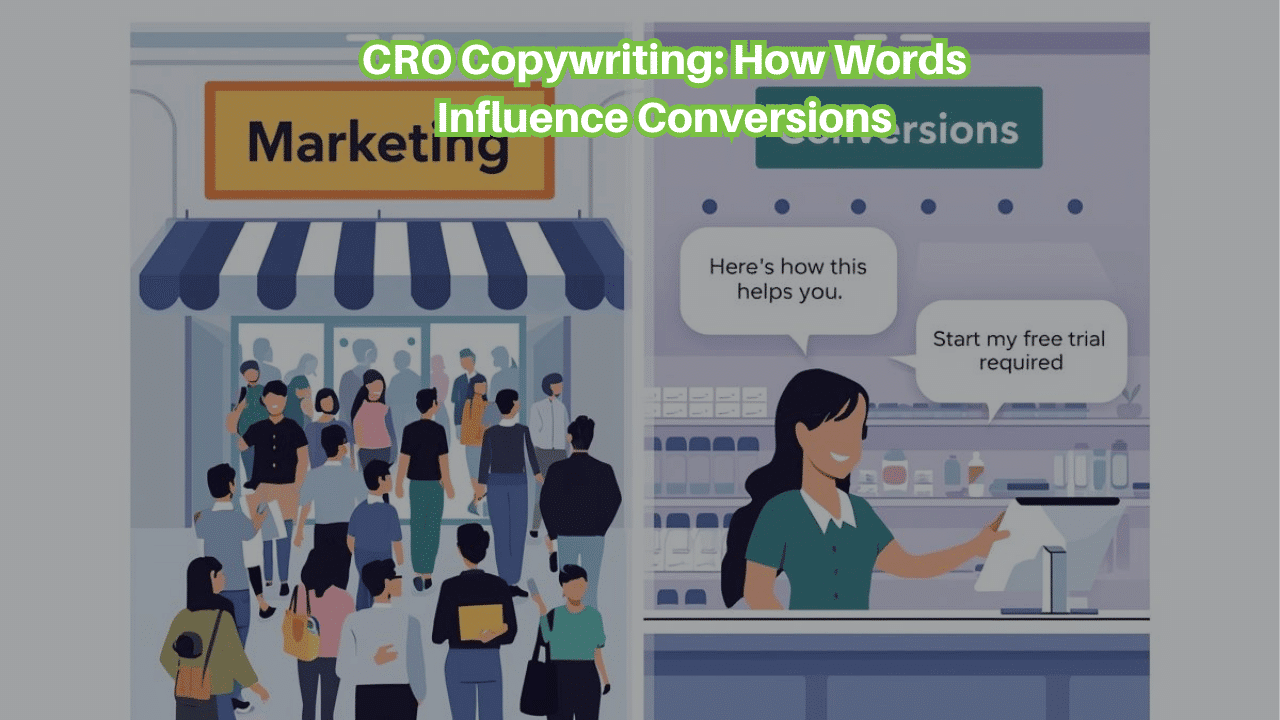
Think of it like a physical store. Traditional marketing gets people through the door. Conversion rate optimization makes sure they actually buy something once they’re inside. The words on your website are your sales team, available 24/7.
In practice, even small wording changes can create measurable impact. For example:
- “Start your free trial” vs. “Start my free trial”
- “Submit” vs. “Get my quote”
- “Learn more” vs. “See how it works”
The second option in each pair feels more personal and benefit-driven. That’s the essence of conversion-focused copywriting: clarity, relevance, and motivation.
A common mistake is writing what sounds clever instead of what sounds clear. Users don’t convert because you’re creative, they convert because they understand the value and feel confident.
How Words Psychologically Influence Conversions

Clarity Reduces Friction
Confused people don’t buy.
When visitors land on a page, they subconsciously ask:
- What is this?
- Is this for me?
- What do I get?
- What happens next?
If your headline or call-to-action doesn’t answer those quickly, they leave.
For example, instead of: “Revolutionizing Digital Experiences”
Try: “Build High-Converting Landing Pages in Minutes”
The second version clearly states the benefit and outcome.
Tools like Hotjar or Google Analytics often reveal high drop-off rates on pages where messaging is vague. In real client projects, simply clarifying the value proposition has increased sign-ups by double digits.
Emotion Drives Decisions
Logic justifies. Emotion decides.
Words that trigger emotion like security, urgency, belonging, success, move people forward. For example:
- “Join 10,000+ marketers”
- “Limited spots available”
- “Stop wasting money on ads that don’t convert”
These phrases work because they connect to fears or aspirations. Effective website copy doesn’t manipulate; it empathizes. It shows you understand the reader’s problem better than they can articulate it themselves.
Specificity Builds Trust
Vague claims weaken credibility. Specific details strengthen it.
Compare:
- “We help businesses grow.”
- “We helped a SaaS startup increase demo bookings by 37% in 60 days.”
Which one feels more believable? In persuasive content writing, specificity signals experience and proof. That’s a cornerstone of trust.
Practical CRO Copywriting Tips You Can Apply Today
Audit Your Headlines First
Your headline does most of the heavy lifting. Ask:
- Is the benefit clear?
- Is the outcome specific?
- Would a stranger understand it in 5 seconds?
If not, rewrite it.
Strengthen Your Calls-to-Action (CTAs)
Instead of generic buttons like:
- Submit
- Click here
Use benefit-driven CTAs:
- Get my free strategy
- Start saving today
- See pricing plans
A small tweak in CTA language can significantly impact conversion rates.
Address Objections Before They Arise
If users hesitate, it’s usually because of doubt:
- Is it worth the price?
- Can I cancel?
- Does it work for someone like me?
Answer those concerns directly in your copy:
- “No credit card required.”
- “Cancel anytime.”
- “Used by startups and enterprises alike.”
In practice, removing uncertainty is often more powerful than adding hype.
Words are not decoration, they are decision triggers. When aligned with user intent and supported by data, the right message at the right moment can turn visitors into customers consistently and predictably.
FAQ
1. What is the difference between copywriting and CRO copywriting?
Traditional copywriting focuses on persuasive messaging. CRO copywriting specifically aims to improve measurable actions on a page, using data, testing, and user behavior insights to refine results.
2. How can I improve conversions without redesigning my website?
Start with your words. Clarify your value proposition, improve your headlines, make CTAs more benefit-driven, and address common objections. Often, optimizing messaging delivers faster results than a full redesign.